Search This Blog

Monday, March 20, 2017

The Juicy Past: Samuel Bonnell Fined for Cohabiting With Another Man's Wife

The latest from John Bunnell on Samuel Bonnell:

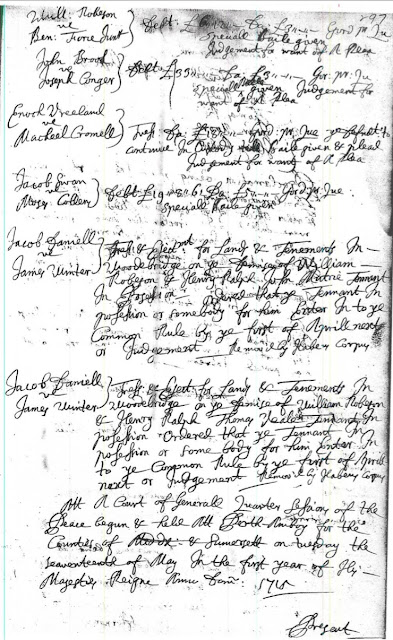
I apologize for being off the grid for many months now...it is a busy world out there.  In any case, here are the first set of documents I promised in the fall.  They are a collection of excerpts from a 1715-1716 court case against Samuel Bonnell (1) in the combined Middlesex and Somerset County Court found in the New Jersey State Archives in Trenton.  Samuel (1) [CB280017] was the son of Nathaniel Bonnell of Elizabethtown, New Jersey, who was, in turn, the son of William, the original immigrant.

There are five related references.  

  • The first two are just calls for his appearance before the case went in front of the Grand Jury.  
  • The third excerpt is the Grand Jury ruling sending the case to trail.  
  • The fourth reference is his conviction with an appeal by his lawyer.  
  • The last reference is the failure of the appeal and the resulting fine.  

The charges in the case were fornication and cohabitating with another man's wife.

Overall, the case supports William Austin's speculation (described in his book) that Samuel (1) split from his first wife (Abigail) some years before. Samuel then apparently took up with another woman, perhaps the Susannah Randolph we see mentioned in 1728.  Before we criticize Samuel (1) too quickly, I think Samuel's "not guilty" plea and effort to argue his "reasons" on appeal indicate that it may not have been a simple situation. Whoever the woman was, she appears to have been the mother of Samuel Bonnell (2) who was the father of William Bonnell of Mercer County, Kentucky.

If nothing else, these documents prove that Samuel (1) was still alive and kicking in 1716.  He did not die in 1715 as listed in Austin's book.  As you remember, we have already discounted that as confusion with the death of a Samuel Bonnell child of another New Jersey line.

Also, there are some tantalizing clues to explore.  First, the witnesses against Samuel appear to have been Hugh and Agness Reid.  I searched through New Jersey documents and did find the elderly widow Agness Read as the Plaintiff in a 1741 court case in Middlesex County.  I read the one document regarding this later case, but there was nothing I could find that would connect back to the Bonnells.  What I have yet to investigate, however, are Mr. Vernon who was Samuel Bonnell's lawyer in the case, and William Ilshe (can use help confirming the last name) who appears to have been his surety for bail after the Grand Jury indictment.  Perhaps these individuals will point to where Samuel (1) may have been living at the time.

Finally, the fact that the first reference is "bound over" indicates that there must be a prior, initial reference to this case in the order books.  I looked carefully while I was in the archives and did not catch it.  Either I missed it (entirely possible since the records from this time are so difficult to read), or it occurred in one of the gaps in the fragmentary
order record.

George Farris added:

Thanks, John.  I don't find anything to add regarding the people involved in this case other than that several were from Woodbridge.  And we had earlier found a reference to the fine in the Woodbridge records in 1715 - so Samuel  was still living in Woodbridge at the time of these court actions. One little dichotomy is that Susannah was listed as his wife in the 1707 birth record for Samuel, Jr. and in 1815 he was charged for living with someone else's wife.  I don't think there are enough surviving records to sort this out completely.  There were other Reids/Reads in Woodbridge but I haven't seen any other reference to Hugh and Agness Reid.

Regarding the surety for Samuel Bonnell referenced in one of these records, there were several members of a family in Woodbridge at that time as referenced in Joseph W. Dally's book whose names are variously spelled Illsley, Inslee, Ilsly, Ileslee, and Ilslie.  It appears that William Ilslie was the one who was the surety for Samuel.  He was married in Woodbridge in 1700 and was one of the surveyors for the several additions to Woodbridge over the years.
=====================================
Transcription

17 May 1715 (p. 297-298):
Dom Rex }
   v } bound over by Recognizance being call’d Appeared & continued on his 
Samuell Bonnell } Recognizance till next Court 
Hugh Reid & Agness his wife sworne & sent to the Grand Jury – then the Court
Ajourned till two a Clock In the Afternoone

16 August 1715 (p. 303-304):
Dom Rex }
   v } bound over by Recognizance being call’d Appeared
Samuell Bonnell }

17 August 1715 (p. 305):
The Court mett According to Ajournment.  Then the Grand Jury came Into Court were call’d over & brought In ye following – Indictment (viz) one Against John Moore for forcibly carry away Rails belonging to David Donham to which sd Moore pleaded guilty & submitted to ye bench who fined him six Schillings & pd.  one Against Samuell Bonnell for fornication who pleaded not guilty & In open Court Acknowledged himselfe to be Indebted to our Sovereigne Lord ye King In ye sum of twenty pounds & William Ilshe did Also Acknowledge himself In ye Sum of twenty pounds on condition that ye sd Samuell Bonnell Appear & answer at ye next court/  And an other Indictment Against Thomas Litten and Hannah Litten for fornication & one Against George Davison for fornication Against whom the Court orders prosecution/ then ye Grand Jury having no further business to do were discharged--

15 November 1715 (p. 308)
Dom Rex }
   v } upon an Indictment for fornication to which he pleaded not guilty & on ye tryall
Samuel Bonnell } ye Jury found him guilty Mr Vernon on behalf of ye defendant moved for a 
rreetal Judgement ye reason whereof ye Court will consider of.

21 February 1716 (p. 311)

Dom Rex }
   v } as an Indictment of Cohabitating with another man’s wife & it was argued 
Samuel Bonnell } before the Bench    M Gordon pro for ye Planiff 
M Vernon pro for ye Defndt.  
the Court overruled the Defndts Reasons and fined him the D Samuell Bunell 
in the sum of fifteen pounds and the Costs to be in the Sheriffs Custody till

payment be made
====================================================


Wednesday, March 1, 2017

Who Was Joseph Bonnell's First Wife, if Rebecca Dod(d) Riggs Was His Second Wife?


Charlie Bonnell asked me to post this–can anyone help?

A typical genealogical puzzle – Joseph Bonnell, 280016 in Claude’s database, supposedly married Rebecca Dod(d) in 1705 and they supposedly had 4 children: Joseph, 1706-1761; Phebe, 1708-; Keziah, 1710-1759; Samuel, 171_ - ?.  The problem is Rebecca was the widow of Samuel Riggs who didn’t die until about 1709/1710.

In the New Jersey Calendar of Wills, 1670-1760, page 386 (see screen shot below, from Ancestry.com:  Samuel’s will was dated 31 Jan 1709 and made his wife, Rebecca the executrix. The will was proved May 16, 1711, “and on the same day the executrix, then wife of Joseph Bunnell, sworn in.” 

Rebecca and Samuel had one child, Sarah Riggs born in 1710. 

So it appears that the earliest that Rebecca and Joseph would have likely married was 1710. Thus, Joseph’s first 2 children, Joseph and Phebe, should not have been Rebecca’s.

Has anyone found anything that would lead to a name for a probable first wife of Joseph before Rebecca?


Saturday, February 18, 2017

Margaret Watson Cooke's Research on Aaron Bonnell & Ann Brotherton Descendants

My great-aunt Margaret Watson Cooke corresponded with Bonnell descendants all over the country. In 1963 she gave my family the last version of her compilations. Somehow I ended up with many earlier versions, many with handwritten notes and corrections (she typed everything herself).

In comparing the work on my direct line I found the final version did not include two of my great-grandmother's siblings who had died as children. I had direct knowledge that Aunt Margaret knew all about them–they're discussed in the book Margaret's mother wrote and that Margaret treasured.

A careful comparison of the versions showed that in the fifth version she had dropped every individual who died as a child. In some cases she also deleted people who'd died as unmarried young adults. I'm guessing she did it to reduce the typing workload. Maybe one of you knows why since some of your relatives may have corresponded with her.

For my own purposes I retyped her work, including every individual she'd identified regardless of their age at death. The only person, other than me, who saw this was Charlie Bunnell. Somehow that seems selfish, so I put it on Archive.org, where I put the books my grandparents wrote about their families.

If you are interested in looking at it, you can find it Margaret Watson Cooke's Compiled Descendants of Aaron Bonnell and Ann Brotherton.

Thursday, February 16, 2017

Photographs of the Henry Bonnell-Amelia Mattox family

I have quite a few photographs of the Henry Bonnell-Amelia Mattox branch, so I thought I might as well share them. More photos can be found in the book their daughter Margaret Alice Bonnell wrote about her family. I made it available on Archive.org through the link here: Family of Henry Bonnell & Amelia Mattox. Information on Margaret's husband and children is contained in the book he wrote, available here Family of Jon Watson & Agness Begg. I am sorry that none of the photos are dated. I'm just glad someone wrote names on the backs.

If any of you have similar collections, let me know and we can post them here too if you like.

Of all these people, my personal favorite was Kate Bonnell because I found her trunk in a closet at the family home in Barry, Illinois when I was a child. Naturally I asked about her and learned she was my great-grandmother's sister. The stories I was told were the first that made me curious about my ancestors. Who knew dead people could be so interesting? Kate was a school teacher, a single woman who left her family and friends and taught out west, in places like Wichita, Kansas when it was still a cowtown. She taught in the Salt Lake City, Utah schools when control was transferred from the LDS church to the government. She taught 75 first graders in the morning and another 75 in the afternoon, ultimately having a nervous breakdown. Articles in Salt Lake newspaper support the stories. She spent the rest of her life with her sister in Barry. When she died suddenly of pneumonia in 1902 the Salt Lake City papers published her obituary, noting her work in the schools there. Judging by the lengthy obituary in the Barry newspaper, she was well-liked there too.

I'm just glad I didn't know as a child that she died in the room I always slept in when I visited my grandparents. Some things are best learned as an adult. The huge cabbage roses on the wall paper were creepy enough when I a kid. Plus the room had no wall switches or outlets, only a lamp hanging from the ceiling. At night you turned on the light by waving your arms around over your head until you found the dangling cord. Good times.


Amelia Mattox Bonnell
Wife of Henry Bonnell

A collection of Bonnell-Smith and Watson Relations
The seated man on the far right, in front of the giant fern, is William Walcott Watson, husband of Margaret Alice Bonnell. She is seated in the middle of the front row, with her daughter Margaret in front of her. Margaret was born in 1899.

Helen Bonnell Smith
Daughter of Henry Bonnell & Amelia Mattox
Helen Bonnell Smith, wife of Eugene Smith  (left) and her sister-in-law Emma Smith
Emma Smith
Helen Bonnell Smith's sister-in-law, sister of Eugene Smith

Stanley Smith
Son of Eugene Smith and Helen Bonnell
Stanley Smith
Son of Eugene Smith and Hellen Bonnell

Stanley Smith and his paternal grandfather Nathaniel Smith
Stanley's parents were Eugene Smith and Helen Bonnell.

Charlie Bonnell
Son of Henry Bonnell & Amelia Mattox
Kate Bonnell in Wichita, Kansas
Daughter of Henry Bonnell & Amelia Mattox
Kate Bonnell in Britingham
Daughter of Henry Bonnell & Amelia Mattox

Kate Bonnell (left) and other teachers in Wichita, Kansas
Kate is the daughter of Henry Bonnell & Amelia Mattox


Jane Eberhardt Smith Bonnell
Wife of William Wayland Bonnell

James Pierce
Husband of Jennie Bonnell, daughter of Henry Bonnell & Amelia Mattox

Hubert Farwell, Bonnie Farwell, Maro Farwell
Children of Belle Bonnell and Hart Farwell

Bonnie Farwell
Daughter of Belle Bonnell and Hart Farwell
Maro Farwell and his grandmother Farwell
Grandson and Grandmother
Nellie Burleigh, Gertrude Burleigh and William Burleigh
children of Mary Elizabeth Bonnell & Demoine Burleigh
Photograph taken Horton, Kansas

Gertrude Amelia Burleigh
Daughter of Mary Elizabeth Bonnell & Demoine Burleigh
Photograph taken Minneapolis

The photo has "Stella Bonnell" on the back.
She is probably Emily Estella Bonnell, born 7 October 1873 Griggsville, IL and died 8 July 1899 at Fairfield, Illinois, according to the book Margaret Alice Bonnell Watson wrote.. She is another child dropped from Margaret Watson Cooke's compilation of Bonnell descendants.

Written on the back: "Ralph Bonnell in Heaven"
This is probably Benjamin Ralph Bonnell. According to Margaret Alice Bonnell Watson's book, he was born 7 October 1875 at Astoria, Ill and died there 28 December 1878, and is buried in Astoria. He was the son of Joseph Gatch Bonnell and Sarah C. Metz.
Margaret Watson Cooke listed him in her early compilations of Bonnell descendants, but in later versions she dropped him and all the descendants who did not reach adulthood.
Alva Belle Bonnell
Daughter of Joseph Gatch Bonell


Monday, November 21, 2016

Obituaries on the Bunnell Family Website

Charlie Bunnell is the creator and keeper of the Bunnell-Bonnell Family website. He keeps us up to date on his activities on our behalf. Here's his latest:

Starting in 2013 I collected every Bunnell/Bonnell obituary I could find and copied each one. In some cases, I did shorten them and just kept the information of value to genealogists. I believe that was done primarily with the 2013 obits. 

I have now added the obituaries for 2013, 2014 and 2015 to the members’ page which all of you have access to.  I do not have all that data entered into Claude’s database, but I am plugging away at it. 

So take a look at the member’s page and let me know if you have any problems accessing the obituaries.

Happy Thanksgiving,

Charlie

There's always a link to his site on the right, but here it is again Bunnell-Bonnell Family website.

Happy Thanksgiving from all of us Bunnell-Bonnell researchers.

Monday, September 19, 2016

Resources Available at Rutgers University, the State University of New Jersey

Ronald L. Becker Head of Special Collections and University Archives at Rutgers University Libraries, has replied to queries about information available at Rutgers:

Information on their genealogical resources guide is available online at
Rutgers Genealogical Resources. Also available is pdf document 

He did a search of their online catalog under "Bonnell family," with the following results


I did a search for "Bonnel" and "Bunnell" and found, in addition to the above:


People with Bonnell/Bunnell in their names have written many books on a variety of subjects.

Mr. Becker also reported the Middlesex County records at Rutgers consist generally of:

Marriage registers and indexes, 1795-1928
Public road surveys, 1705-1828
Deeds and land conveyances, 1714-1722
Official oaths, 1779-1831
Sheriff bonds, 1807-1929
Slave manumissions, 1800-1825
Court of Common Pleas minutes, 1683-1736, 1755-1771, 1783-1793, 1798, 1802-1871
Court of Common Pleas judgements, 1799-1858
Court of General Quarter Sessions minutes, 1683-1736, 1755-1771, 1783-1793, 1798, 1802-1871
Court of Oyer and Terminer minutes, 1799, 1805-1835, 1842-1869,
Circuit Court docket, 1839-1873
Circuit Court minutes, 1799, 1805-1826, 1838-1857
Circuit Court judgements, 1838-1855, 1858-1861

Saturday, September 17, 2016

More on Hightstown and the Bonnells Who Lived There

More from Bob Craig of the Hightstown-East Windsor Historical Society (written to George Farris):
I do need to go further on some points, however.  You are right that few Windsor Township records exist.  In fact, the only ones that I've been able to find in very, very extensive searching are the minutes of the annual meetings for 1761, 1762, 1763, and 1764, and 1772, 1773, and 1774.  These, themselves, were not originals, but rather contemporary manuscript copies submitted to the Middlesex County court.  I have found no Windsor Township minutes for other years.  The township appointed only two constables each year, and of the fourteen names in those seven years, only one, John Updike Jr., was represented more than once.  

It is possible that Bonnell may have been incidentally identified in one or another surviving Middlesex County record, but given the clear pattern among surviving records, I would ask you to identify the earlier documents that list Bonnell as a constable.  When he was named a constable in 1762, he did not succeed himself.

(for other reasons, I would also ask that you let me know what documents or other sources identify him as a blacksmith.)  The tavern that he occupied and ran stood across the road (Main Street) from a blacksmith shop.

Hoagland's gristmill was actually on the north side of Rocky Brook, not the south side (several secondary sources have gotten this point wrong, but the original manuscript sources are very clear on this point.  Even so, you are right that the tavern and the mill were only a few hundred feet apart.

Some other questions for you.
Do you know when Samuel Bonnell first appeared in Windsor, and was it in the Penns Neck area?  When did he first appear in the Hightstown area?

The movement of Hightstown-area families to Loudoun County, VA is something that the Society has not carefully studied, but we are aware of members of several families who made that move between 1760 and 1775.  One of them was Richard Major, the blacksmith who operated the blacksmith shop across from Bonnell's tavern, who left Hightstown ca.1766, and one of John Hight's sons, Thomas Hight, who left for Virginia prob. in 1770.  There were others.

From George Farris to Bob Craig:
Most of the references to Samuel Bonnell as a Constable are within the context of several court documents over a period of many years, not in documents addressing his appointments as constable.  Some of the court documents show both Samuel and Samuel, Jr. as being blacksmiths. 

Regarding the location of the mill, thanks for the correction.  I had misinterpreted the reference to it being on the southeasterly side of the road at Rocky Brook when he bought it from James English, Jr. in 1758.

We have copies of a few pages from Loudoun VA tax lists for 1768 - 1771 - but only the pages listing Samuel and William Bonnell.  However, fortunately, the 1770 list was not sorted alphabetically so it's possible to see who lived near each other.  There are no Majors or Hights showing up on the page with the Bonnells.  However there are a Daniel and William Hutchinson.  Were these a part of the Hutchinson clan from that area?
From Bob Craig:
One further clarification, if you will permit me.  The constable was a local office, appointed by the township at the annual meeting on the second Tuesday in March.  Tavern licenses were issued by the county court of special quarter sessions of the peace during court sessions that were held quarterly, in January, April, July, and October.  So the use of the word "simultaneously" would seem to be slightly amiss.  Does the court minute in January 1763 specifically address whether Bonnell yielded his tavern license and his position as constable at the same time?  (if so, that would further strengthen the circumstantial evidence of a link between those positions.)

The constables worked closely with the justices of the peace, and delivered writs, arrested charged persons, and so forth.  This would help explain their names appearing in the county court minutes. 

From John Bunnell to Bob Craig;

You are correct that “simultaneously” was my interpretation.  There is no direct link between the change in tavern proprietorship and change in constable appointment in the Minute Books for the Court of Common Pleas.  They just appear to happen coincidentally.  Of note, Samuel Bonnell appeared to become less diligent with his constabulary duties in the 1760s, as he was fined several times for “default,” which seems to mean that he did not appear in the quarterly court session when the constables were called.  So, either his mounting debts, poor health, or a combination of the two may have led to an inability to carry out his public duties, thus necessitating the change in appointment to Benjamin Ward.  

A correction to me email before. The three tavern licenses I described were split between the January and April 1761 terms of the court.  (I mixed up the pages, serves me right for trying to do this in a hurry last night…) Here is the corrected description:

Regarding the Taverns, Samuel Bonnell is first connected with a tavern in April 1757, when he performs as a surety for John Height’s application for a tavern license.  Regarding the tavern that Samuel Bonnell eventually ran, the previous proprietor, James English (a fellow constable) received his last license in January 1761 for the “the house where he now lives in Windsor.” Three months later (April 1761), proprietorship shifts to Samuel Bonnell, for the house “where James English lately kept tavern in Windsor” (John Silver and John Smith suretys).  Several entries above that in the Minute Book, John Hight, for whom Samuel Bonnell previously served as surety, is granted another license for “the house where he lives in Windsor,” with the same two individuals, John Smith and John Silver, acting as suretys.  In April 1762, Samuel Bonnell’s tavern license is renewed, but he also serves as the surety, along with James Brooks, for John Smith’s tavern “at Cattail Brook in the South west part of the County.”   In January 1763, as has been mentioned, Benjamin Ward is awarded a tavern license “in the house where Samuel Bonnell lately lived in Windsor.” Benjamin Ward also assumed Samuel Bonnell’s constabulary position in March 1763.  

Your question below regarding sources is key.  I followed your footsteps exactly, finding the appointment of officers documents from 1761 forward in the loose papers of the Middlesex Court of Common Pleas kept in the State Archives in Trenton.  That is where we were stuck until two weeks ago, frustrated that the officer selection documents for Windsor do not exist prior to this date.  The ground-breaking new source is the Minute Books from the Middlesex Court of Common Pleas just now available to the public after the archival work at Rutgers.  These books record the officer appointment results for Windsor each April session, not only confirming the information we already have, but now providing the officer information for previous years.  I only copied the ones that applied to me, but I have the officer lists for 1736 (John Clarke, Constable), 1756 (Samuel Bonnel and William Mounteer, constables), 1758 (it says to continue the same officers as the previous year), and 1760 (Samuel Bonnel and James English, constables).  Officer listings for 1757 and 1759 may be there as well, I may have just missed them.

This brings up a point where we could certainly use help from our new friends in New Jersey.  We’ve discovered that navigating the Byzantine world of New Jersey documents is tremendously difficult.  Just to take the Middlesex Court documents as an example.  The Court of Common Pleas Minute Books are at Rutgers (only now available to the public via microfilm), the Court of the Oyer and Terminer Minute Books (debtors court) are at Princeton (may not be available to the public), the loose papers (writs, etc) emanating from both of these courts  are what we have been sifting through at the State Archives at Trenton (only being indexed for the earlier years).  It absolutely baffles me why all these documents that were produced by the same organization (the County Court at Perth Amboy with the same Justices, Sheriffs, and Constables throughout) should be spread amongst these disparate agencies.  We will certainly need your help and advice to answer questions such as:  how do we get access to the Oyer and Terminer Minute Books?  What else is available in the Special collections at Rutgers and Princeton for which we are not smart enough to ask?  What other records exist for local governments, churches, etc, that may supplement what we are finding at the larger establishments?

We have been working this remotely (I live in Colorado, George lives in Tennessee, John Grady lives in Houston, etc.), so we have wasted much of our very limited on-site research time by not having a good understanding of the available documentation and the potential value of each source.  We would greatly value your input to make us more productive in the future.          

Samuel Bonnell (1), Samuel Bonnell (2) and Edward Bonnell in Middlesex County, New Jersey

John Bunnell's latest report on the Samuel Bonnell sorting:

As George (Farris) stated, the documentation seems to indicate that Samuel Bonnell was a Constable of Windsor from at least 1744 until 1762.  There are significant gaps in the Middlesex Court records during this period, but Samuel seems to be there whenever the records exist for his adult life.  A newly produced microfilm in the New Jersey State Archives (courtesy of recent archival work by Rutgers University) shows the a fairly complete set of Minute Books for Middlesex County through 1736.  The only mention of the Bonnells I’ve found in this time is for the father of the individual we are investigating here (also called Samuel Bonnell (1)), who is mentioned in a series of actions involving an adultery case that eventually leads to his conviction and an assessment of a fine in 1715.  Of note, Samuel Bonnell (2) is not a constable of Windsor in 1736 (the last year before the record gap), as that position is occupied by John Clarke.  George and I assess that the adultery case probably led the family to relocate to Somerset County during that period, thus explaining several of the court documents that emanate from that county during this time.

There is a gap in the Middlesex County Minute Books from 1737-1754, denying us the ability to do the year-by-year tracing that we can do earlier and later.  Nonetheless, the items we have found in the loose papers indicate that Samuel Bonnell (2) returned to Middlesex County and assumed the position of the Constable of Windsor during this time.  The first mention of this we’ve found so far is from 1744.  This is actually a fairly entertaining case where Samuel was ordered to legal action against an individual who was a law officer in another jurisdiction (New Brunswick).  Samuel, in turn, was arrested as he attempted to execute this order, leading to an argument between the officials in the two townships.  The next case, also from the free court papers, is in March 1755, when Samuel is deposed to deliver a letter from the court to William Walker concerning a land dispute.

Once the Middlesex Court Minute Books pick up again in 1755, Samuel is consistently noted performing constabulary duties.  The annotations are there for the Court Terms of October 1755, April 1756, July 1756, July 1757, April 1758 (by implication), January 1759, April 1759, April 1760, October 1760, April 1762, and October 1762

Regarding the Taverns, Samuel Bonnell is first connected with a tavern in April 1757, when he performs as a surety for John Height’s application for a tavern license.  January 1761 seems to be the big transition point for the Windsor Township Taverns, with licenses simultaneously issued for James English (“in the house where he now lives in Windsor,” John Hight and Vincent Dye his recognizance, Timothy Frazee and David Stewart his suretys), John Hight (“in the house where he lives in Windsor,” John Smith and John Silver suretys), and  Samuel Bonnel (“in the house where James English lately kept tavern in Windsor,” John Silver and John Smith suretys).  In April 1762, Samuel Bonnell’s tavern license is renewed, but he also serves as the surety, along with James Brooks, for John Smith’s tavern “at Cattail Brook in the South west part of the County.”   In January 1763, as has been mentioned, Benjamin Ward is awarded a tavern license “in the house where Samuel Bonnell lately lived in Windsor” and simultaneously assumed his role as constable.

I know I need to scan and transcribe these more recent discoveries and get them out to everyone.  (I’m a single point of failure here…)

I think I have mostly exhausted the resources in the NJ State Archives, so George is on the right track to look for data sources beyond Trenton.  The archivist at Trenton recommended I contact the administrator for the Rutgers Special Collections.  I sent the email but not yet received a response.  I did sort through the fragmented annotations (marriages and births) for the Cranberry Presbyterian Church (just north of Hightstown) located in the State Archives, but did not get any hits within these clearly incomplete listings.

Bob Craig of the Hightstown-East Windsor Historical Society added:

Thanks for all of this information.  One further clarification, if you will permit me.  The constable was a local office, appointed by the township at the annual meeting on the second Tuesday in March.  Tavern licenses were issued by the county court of special quarter sessions of the peace during court sessions that were held quarterly, in January, April, July, and October.  So the use of the word "simultaneously" would seem to be slightly amiss.  Does the court minute in January 1763 specifically address whether Bonnell yielded his tavern license and his position as constable at the same time?  (if so, that would further strengthen the circumstantial evidence of a link between those positions.)

The constables worked closely with the justices of the peace, and delivered writs, arrested charged persons, and so forth.  This would help explain their names appearing in the county court minutes.

BTW, there is a reference to an Edward Bonnel having been a blacksmith in Somerset County in 1740.  Is this part of the story also?


Another interesting pattern in the tavern license material is the frequency with which tavern keepers served as sureties for one another.  

I'm not sure what to make of this tidbit, but when Bonnell was first licensed, his sureties, Silver and Smith, were not from the Hightstown area, but rather from the area now encompassed within Robbinsville Township.  Likewise, when Smith was licensed in 1762, his tavern was at "Cattail" (New Sharon on the Old York Road), but a year later Bonnell reciprocated for Smith.  It turns out that Smith died not long afterward, so neither man was a local tavern keeper very long.

George Farris on Edward Bonnell:

I don't think Edward Bonnell has been identified among the related Bonnell lines of NJ.  Yes, we've seen the article about him breaking out of goal in 1740 in Somerset. There was later an Edward in Monmouth Co. - and several other Edwards over the years.  Charlie Bunnell is the keeper of the Bonnell/Bunnell database and I will let him comment if he knows more about this Edward.  He wasn't part of the Samuel Bonnell family as far as I know.


Help from the Hightstown-East Windsor Historical Society

George Farris reported:
Since John’s research at the NJ Archives had pinpointed Hightstown, NJ as one of the specific places where Samuel Bonnell had lived, I contacted the Hightstown - East Windsor Historical Society to see if there might be any local information remaining regarding him or other members of the family there.  Cappy Stults is the current President of the Society and he did quite a bit of searching of the available records with very limited success.  

The one specific that came out of this is the exact location of the Inn and the fact that Samuel Bonnell lived there for a short time. 

Mr. Stults responded: 
Although I have not totally given up, everything has been a dead end. I have not found any Bonnell’s. Hightstown was a very small hamlet prior to the railroad in the 1830s. Although we had a mill and inn, there was not even a church until the 1780s. Years later many may have referred to Hightstown even though they may have been in Millstone or Cranbury Townships, or even what are now West Windsor or Plainsboro Townships, all within 5 miles of Hightstown.

Mr. Stults asked “the real expert,” Bob Craig, for help. Mr. Craig wrote 

On Samuel Bonnell, I have only one record of him as constable.  He was appointed constable for the year 1762-3 at the annual Windsor Township meeting in March 1762.  The surviving records on constables show that they were typically one-year assignments with almost no succession.  They often included a tavern keeper, usually in the first year of his license (evidence of a quid pro quo ?).  Thus John Hight was appointed constable in 1751, the first year of which there is record of him as tavern keeper.   Samuel Bonnell was first licensed as a tavern keeper in April 1761; before his first year of licensure was completed, he was appointed constable in 1762.  Bonnell was re-licensed in April 1762, while still constable.  In January 1763, before his year was out, he was succeeded as tavern keeper by Benjamin Ward in 1763.  Ward, in turn, was appointed constable in March 1763, in the first year he was licensed.  This pattern is strong enough that there was clearly something unstated going on.  

In the court minute when Benjamin Ward was licensed in January 1763, it was noted that the tavern was kept "in the house where Samuel Bonnel [sic] lately lived in Windsor ..."  Note the past tense, "lived."  This tavern stood on the site of Cunningham's pharmacy, the southwest corner of Main and Stockton streets, Hightstown.  The tavern was built about 1755, and stood (I think) until the late 1850s when it was demolished.

So I can only place Samuel Bonnell in Hightstown for this brief interval in the early 1760s.  These are the only references that I've found to Bonnell in my notes.


William Bonnell of Mercer County, Kentucky Had a Brother Samuel Bonnell Who Stayed in New Jersey

Marjorie Gibbs asked:
I have been following all this with great interest. It must take some kind of record for the depth and breadth of the research you have done, and the careful sorting and analyzing. it’s fascinating. 

Would you retrace a little to help me follow the descent from the original William? I assume the evidence now shows Samuel Bonnell (3) the more likely father of our “Kentucky Bonnells.” Is that right? William Austin suggested that Isaac4 was William’s father. That no longer seems to be the case — Samuel was William’s father, instead of Isaac. Does this mean Isaac4. (Nathaniel3,2, was not our William’s ancestor? Or was it Isaac4’s brother, Samuel4? Or was our William’s progenitor Samuel3, and not Nathaniel at all? Would you line this out for me, please? It looks to me as though you have found three generations of Samuels that weren’t even on Bill Austin’s radar. Is that right? Sorry if I appear rather dense on following this. It’s not your fault.

John’s reply:
Thanks for the note, I know all of this can get quite confusing, especially with the duplicate names.  

I think we’ve now established with reasonable confidence that William Bonnell of Mercer County Kentucky was the son of Samuel Bonnell [2] who was born in Woodbridge New Jersey (26 May 1707), reached maturity in Somerset County New Jersey, spent most of his adult life as the Constable of Windsor, New Jersey, and was an elderly companion of William during his first several moves in Virginia.  

The body of evidence indicates that Samuel (2) had at least one other son, also named Samuel [3], who would have been William’s brother, probably born about five to eight years before William.  Samuel (3) appears to have stayed in New Jersey after the rest of the family moved to Virginia, at least through the Revolutionary War.  

William and Samuel (3)’s paternal grandfather and Samuel (2) father was Samuel Bonnell (1) who is listed on page 57 and 58 of William Austin’s book.  We now know that Austin’s write up is incomplete.  Samuel (1) did not die in 1715 (that was a different Samuel).  Instead, he remained in the public record until at least 1728 and probably 1739.  

Our discoveries reinforce  Austin’s assessment that Samuel (1) split with his wife Abigail and son Benjamin.  It now appears that he took up a relationship with a Susannah (Randolph?) which resulted in the birth of Samuel (2).  The genealogy from here is straightforward and in accordance with William Austin and Claude Bunnell’s work:  Samuel (1) was the son of Nathaniel, who was the third child of the original immigrant William Bonnell.  So, our direct line to the original immigrant was:

-William (of Mercer KY, b. ~1742 in Somerset or Middlesex County, New Jersey)
    - Samuel Bonnell (2) (b. 26 May 1707 in Woodbridge, Middlesex County, NJ; d. probably in late 1770s  in Virginia)
         - Samuel Bonnell (1) (b. ~1675 in Elizabethtown, NJ, d. probably 1740s in Somerset County, NJ)
                 - Nathaniel Bonnell (b ~1640-1642, probably in Massachusetts)
                        - William Bonnell – the original immigrant.

Bonnells and Bunnells in Hightstown, New Jersey

George Farris adds to the discussion of Samuel Bunnells, Middlesex County, New Jersey:

I agree that the 3 generations of Samuels scenario is about the only way to explain all of the references over a period of many decades. As we put together more pieces of this mosaic the picture is beginning to emerge and make sense.   

One of the key things that some of the later records clarify is a second specific location where the Samuel(2) Bonnell family lived.  While they apparently lived in the Penn's Neck area near Princeton and near the western boundary of Windsor Township for many years it's now clear that they later relocated to Hightstown - which is near the eastern boundary of Windsor Township.  

The questions regarding James English and Benjamin Ward are pertinent and help pinpoint the location of the Inn that Samuel Bonnell operated for several years.  James English was the Inn Keeper prior to Samuel Bonnell and Benjamin Ward after Samuel. The brief references that I've found to them describe both as Inn Keepers at Hightstown. James English was later a miller and a blacksmith at Hightstown. 

Hightstown was small and centered on the point where the Kings Highway crossed Rocky Brook - which is where Christopher Hoagland operated a mill from 1758 until his death in 1763.  Since Hoagland owed William Bonnell a small amount of money at his death it appears very likely that William worked for him at the mill.  So we can put a pin on the map at Hightstown, NJ as the earliest specific location where we have identified William Bonnell as living - at least from 1761 - 1763.

That location also helps explain some of the Bonnell records that involve people who lived in Monmouth County.  Hightstown is just a few miles from Monmouth County.

It seems quite possible that Samuel Bonnell(3) served with the 3rd NJ Regiment (the New Jersey Greys).  While the officers were mostly from northern NJ most of the foot soldiers were recruited from southern NJ.   

John Bunnell adds:

That a Samuel Bonnell served in the Third New Jersey is beyond doubt.  I have extensive references to pay, as well as the final pay settlement from 1785 signed by Jonathan Dalton (the youngest signer if the Declaration of Independence).  The only question is whether this is for Samuel (3) or an unrelated individual.  Interestingly, there is also a Revolutionary record for a Samuel Bonnell who skippered a schooner from Elizabethtown to deliver firewood to American forces.

Sorting Out the Samuel Bunnells of Middlesex County, New Jersey

John Bunnell reports:

I apologize for the delay in correspondence, as things have been very busy at home and work.  While I was able to find several more pertinent documents during my last trip to the New Jersey State Archives, I have not been able to scan and transcribe them as I did with the first bunch.  Since I don't know when I will get to that, I'll provide an interim summary of my conclusions.  

The more documents I find, the more I become convinced that we are actually dealing with three generations of Samuel Bonnells in Middlesex County New Jersey.  

To explore this theory, please refer to the attached spreadsheet,(see below) in which I have reorganized the New Jersey documents into chronological order.  

With this, we can see that the differentiation between a Samuel Senior and Samuel Junior happens at two points. 

  1. The first is in Somerset County in 1732.  
  2. The next is a generation later, 1755-1761 in Middlesex County.  
Looking at the ages of the two Samuels we have identified to date (Nathaniel's son, b. ~1675, and grandson, b. 1707), they would have had to have been both very long lived and very active into their elder years to account for all these references.  Indeed, the last reference of them together, in 1761, would require the older Samuel to be still active at 86 years of age.  

I think a more likely scenario is that the Samuel born in 1707 had a son likewise named Samuel in, I propose, about 1738.  This individual would have been the older brother of William Bonnell of Mercer County Kentucky.  The birth year is based on the fact that he first begins to appear in the public record in 1755, at which time he must have reached the age of majority.  I believe he was still connected to Samuel (2) at least through 1761 (same house and business, perhaps).  

Although writs are written against both of them, the court minute books list only the suit against one of them, presumably the father.  

The other argument for this theory is that it explains the continuing presence of a Samuel Bonnell in New Jersey after 1707-born Samuel is already established with William in Virginia.  The spreadsheet is color coded to show what I believe to be the most likely "owner" of each of the documents we've collected.  

Based on the above, I would offer the following as "provisional biographies" of the three generations:

Samuel Bonnell (1):  This was the individual that we already know of from William Austin's work.  He is the son of Nathaniel, born in Elizabeth Town, Essex county, in approximately 1675.  As we have discussed in the past, he appears to have divorced his first wife with whom he perhaps had a son Benjamin.  He then appears to have married Susannah, with whom he parented son Samuel (2) in 1707 after relocating to Woodbridge in Middlesex County.  The family appears to have relocated to Somerset County sometime before 1728.  The last document that probably relates to this individual is the will of John Balm in 1739, when he would have been approximately 64 years old.  Unfortunately, all records of this time from Somerset County were destroyed in a courthouse fire, which is probably why this search is so difficult.  (The Somerset court documents we've found only exist because they were later prosecuted in other counties.)  It is possible, therefore, that Samuel (1) died in Somerset, with the record now lost.

Samuel Bonnell (2):  According to the document found by Margaret, Samuel (2) was born on 26 May 1707 in Woodbridge, NJ.  The first adult mention of Samuel (2) is in the 1732 bond to Richard Carman (he would have been 25 years old), in which he is listed as a blacksmith.  Probably through family connections, Samuel (2) was appointed one of the Constables of the Township of Windsor not later than 1744, holding this post for nearly two decades until 1762.  (Remember that Joseph Bonnell was a judge on the New Jersey Supreme Court and Isaac Bonnell later became the Sheriff of Middlesex County, so the enforcement of the law appears to have been Bonnell family business.)  

Samuel (2) lived in Windsor Township near Penns Neck and had at least two sons, Samuel (3) and William, when he was in his thirties.  In 1761, he purchased an inn and public house from James English, a fellow constable.  By 1763, he sold the inn and public house to Benjamin Ward, who also assumed his position as constable.  Increasingly in debt, all his possessions were confiscated by 1767, causing him to relocate to Virginia with his son William and family friends Jacob Wright (also penniless) and Peter Rossell.  The last document relating to this individual is the letter for the administration of the Estate of Jacob Wright in 1777, when he would have been 70 years old.  He probably passed away in Spotsylvania County, Virginia.

Samuel Bonnell (3):  Samuel (3) should have been born in ~1738 to start appearing in the public record as a legal adult in 1755.  He became a blacksmith like his father.  Although his father relocated to Virginia in approximately 1767, Samuel (3) stayed in New Jersey, being placed in debtors prison in 1770, when he would have been 32 years old.  This may be the individual that was in the Third New Jersey Regiment, raised in Elizabethtown and officered by Jonathan Dalton of Princeton.  (Neither Samuel (1) or Samuel (2) would have been young enough age for military service in the Revolutionary War.)  Samuel (3) appears in New Jersey legal documents as late as 1785, when he would have been 47 years old.    

I welcome your comments and criticisms on the above.  There is still much work that can be done to prove or disprove this this theory and/or flesh out the details.  I'm sure at least some of this is wrong.  Some of specific the "like to knows" are as follows:

  • Who was the Susannah Randolph that was the co-witness, with Samuel Bonnell (1?), on the 1728 bond between Isaac Fitzrandolph and William Beaks?  Was this the mother of Samuel (2) either out of wedlock or using her maiden name?  
  • Who was the Ann Johnson who was the co-witness, with Jacob Wright, on the bond between Joseph Cox and Isaac Ivins in 1763?  Did she become the Ann Wright that we know was his wife (debunking the theory that Ann Wright was a Bonnell)?    
  • Who was James English, fellow constable with Samuel (2), and from whom Samuel purchased the inn and public house?
  • Who were John Smith and John Silver, who were the sureties for Samuel (2) in his application for a liquor license?
  • Who was Benjamin Ward, who both purchased the inn from Samuel (2) and assumed his position of constable in ~1763?
  • Did the witness of the sale of lands from the estate of Charles Wright in 1773 by Samuel (3?) have any connection to Jacob Wright?
  •  Does it make sense that Samuel (3) was the Samuel Bonnell in the Third New Jersey Regiment who was officered by Jonathan Dalton, or has this record been connected to some other Samuel?
Thanks ahead of time for any help you can provide in answering these questions.  I'll try to transcribe and forward the most pertinent documents as time allows.