Search This Blog

Tuesday, April 18, 2017

Samuel Bunnell & William Bunnell–Spotsylvania County, Virginia Petitions

From George Farris:

I've been going through the Library of Virginia's digital collection of "Legislative Petitions."  We had earlier found one such petition in Albemarle Co. that was signed by both William Bonnell and Peter Rossell.     

Attached are two petitions from Spotsylvania Co. in 1777 and 1779 addressed to the House of Delegates and requesting that either Spotsylvania be divided into two counties or that the county seat be moved from Fredericksburg to a more central location.    


The one in 1777 is a single combined list of all the signatories rather than the original petitions so it doesn't include actual signatures. Both Samuel Bunnell and William Bunnell  as well as Peter Rossell are listed on page 2.  


The 1779 document includes all of the copies of the petition that were circulated in various parts of the county and includes the actual signatures, including William Bonnel on page 13, Peter Rossell on page 15, and Dennis Wright (oldest son of Jacob Wright) on page 13.  


There were several other petitions in other years signed by Peter Rossell both in Spotsylvania Co. and Albemarle Co., but these two are the only ones I've found including William Bunnell.


------------------------------------------------------------
John Bunnell added:


These are really amazing documents, and perhaps they will turn out to be some of the most significant we’ve discovered.  

First, the fact that both Samuel and William Bonnell both the 1777 petition but only William signed the 1779 may indicate that ~1778 was the year of Samuel’s passing.  

Second, the mileage information on the 1777 document gives us a tremendous clue as to the location of the Bonnells/Rossells/Wrights in Spotsylvania County.  Samuel and William state that they are 30 miles away from Fredericksburg, with only a few individuals farther away.  The boundaries of Spotsylvania County have been unchanged from 1734 until today.  The county is actually slightly less than 30 miles long, so I have to assume that the distant petitioners are quoting road miles rather than the direct distance.  Nonetheless, this must mean the group was residing in the southwestern end of the county.  This undercuts my previous working theory that William was a carpenter or blacksmith working in the Fredericksburg area.  But, we have to go where the facts take us…

Third, the fact that the signatories on the petitions seem to be grouped geographically give us great leads to follow in order to narrow down the geography.  I’ll dig into this and see if it helps us make any sense of the single Revolutionary War Virginia Navy pay record for a William Bonnell.


------------------------------------------------------------


---------------------------------------------------------------------------------


Monday, April 17, 2017

Isaac Ivins, Jr. and Joseph Cox Debt Case

From John Bunnell:

Here is another document from my autumn visit to the New Jersey State Archives.  This is a debt case between Isaac Ivins, Jr. and Joseph Cox.  As you can see, the witnesses to the 1763 bill obligatory are Ann Johnston and Jacob Wright.  To date, we have theorized that Jacob Wright's wife Ann was originally a Bonnell.  While that is still a possibility, this document suggests we should investigate Ann Johnston as another option.


Unfortunately, I don't know where to look next.  I reviewed the indexes in the State Archives but could not find another reference to an Ann Johnston that seemed to match. 

This is the unfortunate consequence of a time when women were seldom a part of the official record...


Samuel Bonnell Witness to the Will of Charles Wright

From John Bunnell:

I really don't know what to make of this entry for the estate of Charles Wright.  You can see that a Samuel Bonnel was a witness to the sale of the Middlesex County, NJ property when it was consummated in New York in 1773. More than any other document, this raises far more questions than answers.  
  • Was Samuel Bonnel involved because John Blanchard, the executor of the will was from Elizabeth Town?  If so, that suggests that this Samuel would be one of those still living in this northern location, such as Samuel Bonnel #310238 (although he would have only been 18 years old).  
  • Was Samuel Bonnel involved because of the connection to the plot of land in Woodbridge and Rahway Meadow?  If so, that suggests this is one of the Middlesex County Bonnells we've been tracking.  Samuel Bonnell (3), the grandson of the Woodbridge resident, was the only one who would have been alive and still residing in New Jersey in 1773.  
  • Does the deceased Charles Wright have any relation to Jacob Wright who was closely associated with the Middlesex County Bonnells? 
Any thoughts?

-------------------------------------------------------------

Middlesex County, New Jersey Deed Abstracts Book "1"
"These abstracts were derived from the county clerk's copies of the records at the Middlesex County Court House, in New Brunswick, New Jersey. These early deed books contain the county clerk's handwritten recordings of the deeds as they were presented to him for recording. On occasion, other documents are found recorded in these books, such as Release of Dower, Creditor's Agreements, Division of Property, etc."

"[p 38] JOHN BLANCHARD to JOSEPH LESTER

23 September 1773–John Blanchard of Elizabeth Town…Executor of the last Will…of Charles Wright late of the Township of Woodbridge…Middlesex…New Jersey, Mason deceased…[sold to]…Joseph Lester of the City of New York…Whereas, the said Charles Wright…at the time of his death…possessed…land…in Woodbridge…Middlesex…[12.5 acres] whereon the said Charles Wright did live and die…[adjacent land owners or names–Thomas Morris, Peter Elstone Richard Walker]…Also, one piece of Meadow…in Woodbridge Rahway Meadow, being …[adjacent land owners or names–⅓ part of Meadow formerly belonging to Joseph Gray deceased, John Noe, Phillip Dolderidge, the great Creek]…[6 acres]…;[Charles Wright made his Will on 3 May 1770 Whereby he appointed John Blanchard sole Executor.]
[
Lester paid Blanchard for the sale on 23 September 1773 in New York; Witnesses–John Keese, Samuel Bonnel.]

[Hudson Co, New Jersey–Lee W. Jaques and J. Eugenia Jaques appeared and swore that the above land was in Middlesex Co and "was in 1895 conveyed to Jonathan Jaques by said Joseph Lester, and said Jonathan Jaques, their great grandfather, did own & Posses same. Later the above…was owned…by Robert L. Jaques, their grandfather, son of Jonathan Jaques…That the above…parcel of Rahway Salt Meadow was later owned…by Eugene A. Jaques, deceased, late of Jersey City, Hudson Co, New Jersey and that they Lee W. & J. Eugenia Jaques, are the sole surviving children of the said Eugne A. Jaques, deceased…"The deponents swore that the land has been in the possession of the Jaques family for over 100 years; Dated–31 March 1916; Recorded–31 April 1916.]


Sunday, April 16, 2017

Records of Samuel Bonnells in the Revolutionary War

From John Bunnell:

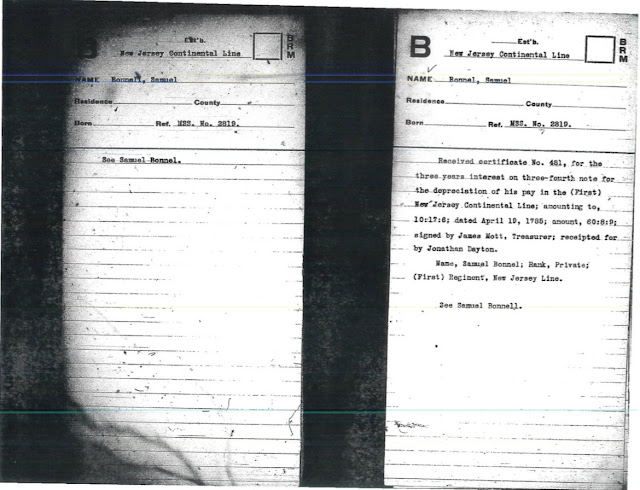
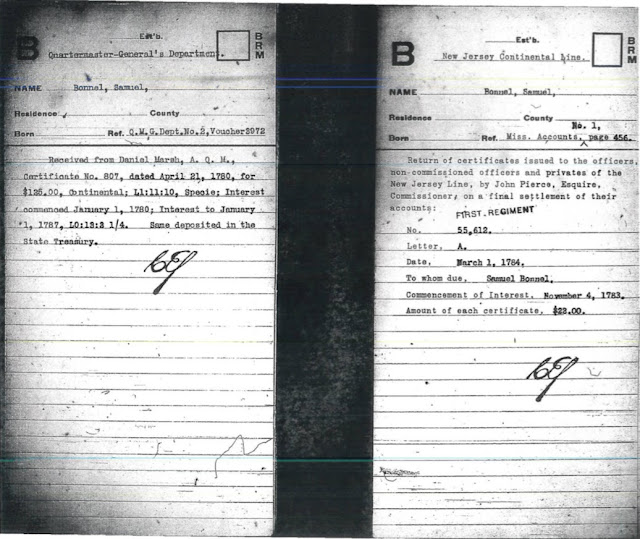
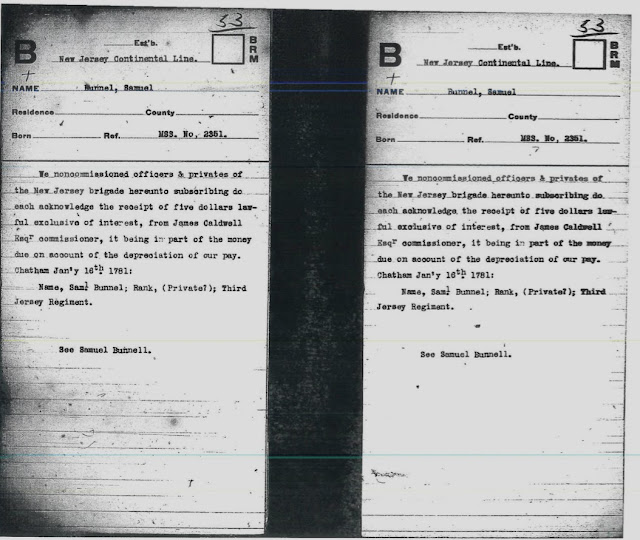
Attached are the records for the New Jersey State Archives for three different listings for individuals named Samuel Bonnel/Bunnell who served in the Revolutionary War.  The first two pages of the "New Jersey Continental Line" PDF show two listings for Samuel Bonnels who served in the New Jersey Continental Line.  The archivist has connected the bulk of the pay documents into a single listing relating to service in the Third Regiment, the First
Regiment, and Ogden's Regiment resulting from transfers and re-enlistments.

This service has already been attributed to Samuel Bonnell (#310238), the son of Benjamin Bonnell.  I have no reason to believe this is incorrect. His ancestors have every right to be proud of the final pay settlement, which is signed by Jonathan Dayton, the youngest signatory of the Declaration of Independence (attached).

The first page of the "New Jersey Continental Line" PDF and the first pay document are a separate listing relating to a Samuel Bonnel who enlisted in Captain Lyon's Company, Fourth Regiment, New Jersey Continental Line on March 25 1778.  I had earlier postulated that this individual may have been "Samuel Bonnell (3)," the Samuel Bonnell, Junior that is listed with his father in Middlesex County Court documents during the 1760s and 1770s.  This assumption was based on the fact that some of the officers of this regiment were from Middlesex County.  After further research, I now believe the more likely scenario is that this enlistment also relates to the Samuel Bonnell (#310238) in the preceding paragraph.  The reason for this is that the Fourth Regiment mainly recruited from Elizabethtown, where #310238 was from Samuel Bonnell (3), however, was living in Windsor Township of Middlesex County, at least until 1770.  The Fourth Regiment was disbanded in Elizabethtown 7 February 1779.  I think it was most likely that #310238 first enlisted in the Fourth Regiment just before it was disbanded. Given that his enlistment was still in force, he was transferred to the Third Regiment, where the other consolidated record picks up the story.  

The more intriguing documents relate to a Samuel Bunnell who was the master of the schooner Swallow.  Samuel Bunnell was contracted by the Commissary General of Prisoners for the United States of America (an American officer) to haul cord wood between Elizabethtown and New Brunswick between January and May 1778 for the use of Americans who were prisoners of war in the custody of the British.  I've accomplished a cursory search for the Swallow, and find that there were many ships by this name.  In fact, the British captured five schooners by this name during the war, see the attached link. 


Unfortunately, I've not been able to find any other information on a ship's
master named Samuel Bunnell or a Swallow operating in New Jersey.  I'm open
to any ideas for further research, particularly from our New Jersey friends
who know the local records better than we do.  While we are far from
substantiating that this reference applies to Samuel Bunnell (3), he would
have been about the right age to be a ship's master.  If there is a nautical
connection, it may shed some light on the Revolutionary War naval pay record
for William Bonnell that we have found in Virginia.

---------------------------------------------


---------------------------------------------


---------------------------------------------


Records of Samuel Bonnell's Tavern in Middlesex County, New Jersey

From John Bunnell:
Here, from the New Jersey State Archives, are the tavern license petitions for Samuel Bonnell in 1762 and then for Benjamin Ward, for the same property, in 1763.  

According to the Middlesex County Court minutes, Samuel Bonnell first received a license in April of 1761 (taking over for James English), so there should be a petition for that year as well.  However, it is not listed in the New Jersey State Archives index.  

Nonetheless, these two documents are illuminating for a couple of reasons.  

First, they list what must be the local gentlemen serviced by this tavern.  We see some familiar names here.  Benjamin Ward, who would purchase the property in 1763, signed as a petitioner in favor of Samuel Bonnell in 1762. Christopher Hoogeland, a petitioner for Benjamin Ward, ran the local mill and had accounts for Samuel Bonnell, Jacob Wright, and the young William Bonnell in 1763.  

Most interesting is the description on Benjamin Ward's petition that indicate he bought the property where Samuel Bonnell of late lived. 
 
Also of note is the fact that the tavern is said to have serviced travelers in addition to the locals.  
I welcome any additional analysis or thoughts on these documents.

---------------------------------------------------------
Samuel Bonill
Samuel Bonnil

To the Honorable Court of Quarter Session to be held at the City of Perth Amboy Aprill the 20th 1762
We the subscribers your Honours Humble Petitioners pray that the Honourable Bench will be pleased to grant License to Samuel Bonill for the keeping a Publick House for retailing strong liquors viz in the house he now lives.
Richard Major
John Hull
John Ely Junior
Wm. Hutchinson Junr.
Daniel South
Joseph South
John Kight
Joseph Wilson
Benjamin Ward
John L Conte

-----------------------------------------------------------

Benjamin Ward


To the Honourable Justices of the Peace of the County of Midlesex in New Jersey at their General Quarters sessions convened in January term Anno Dom. 1763
Herewith
That wheras Benjamin Ward of Windsor in the above said County of Middlesex Hath made a Legal purchase of the dwelling house in which Samuel Bonnel of late dwelt and kept a lisenced tavern and publick house of entertainment, & the lands appurtenances thereunto belonging scituate & lying in above said Windsor, and in the said house hath been kept a licens tavern for many years past to the comfort and refreshment of travelers and others, Therefore we the subscribers do humbly recommend the above sid Benjamin Ward to be a proper person to keep a tavern & publick house and hereby jumbly desire that he may have a lisence for that purposes
Given under our hands the 7th day of Jan’y Anno Dom 1763
Abel Hankins
Ste’n Warnes
Richard Major
Chris’or Floogeland
John Hose
Jacob Jamson
George Nicholson
John Knight
Ric’d Carnster
Rich’d Francis
John Dye
Mattiaas Mound

------------------------------------------------------------------------

Bob Craig, Library chairman Hightstown-East Windsor Historical Society adds: The Bonnell/Ward tavern stood on the SW corner of Main and Stockton Streets in downtown Hightstown.  On the site of what was long known as Cunningham's Pharmacy.  The tavern was probably built about 1755 and was the second tavern in the nascent village.

------------------------------------------------------------------------

John Bunnell: 
I plotted your described location on goggle maps and can see the present day pharmacy at the corner.  I notice the First Baptist Church is just down the street.  However, their webpage says the church did not move to that location from Cranbury until 1785, so that probably doesn’t do us much good.  Nonetheless, do you know if there are any records available from that church for the pre-revolutionary years?  I’ve looked at the fragmented records for the Cranbury First Presbyterian Church, with no results. The Presbyterian Church was then and now remains up in Cranbury.  Perhaps the First Baptist Church always had more of a connection to Hightstown.

------------------------------------------------------------------------

Bob Craig, Library chairman Hightstown-East Windsor Historical Society: 
The congregation was founded in Cranbury in 1745, where it continued to worship until 1785 when its new house of worship in Hightstown was completed.  The church minute book from 1745-> survives; the historical society has a photocopy of it.  The church records, however, are weak for the period of the early 1760s, when Bonnell was running his tavern.  The church was without a settled pastor during those years and record-keeping was spotty.

------------------------------------------------------------------------

Bette M. Epstein, NJ State Archives: Baptist Churches did not baptize children.
They only baptized adults.
Therefore unlike Presbyterian church records their records would not help in identifying the children of Samuel Bonnell.

------------------------------------------------------------------------

John Bunnell: 
Thanks Bette, I would have never known about the baptism procedures.  Even if there are no birth records, I may still peruse the Hightstown First Baptist Church records the next time I am in Trenton, just to see if I can stumble on anything.  It appears the family was a church-going one, as we have tracked the grandkids through at least three churches in Kentucky during the early 1800s, either Baptist or non-denominational (Shawnee Run Baptist Church in Mercer County, Tramels Creek Church in Green County, Little Barren Church in Green County).

We have now narrowed down the search to a very small geographic area.  The best we can tell, the Bonnells were living within about a eight-mile stretch between Penn’s Neck and Hightstown from at least the mid-1740s through 1767.  Are there any other non-published church records for this area?  The Princeton Baptist Church at Penns Neck is optimally placed, but the web-site says it did not open until 1812.

Regarding the tavern license petitions, can you tell us who the petitioners were for James English’s license petitions in 1760 and 1761 and then potentially for John Height in years previous to that?  It almost seems that running this tavern was a responsibility shared between a small number of gentlemen, including, in order (I think), John Height, James English, Samuel Bonnell, and then Benjamin Ward.  It would be interesting if we could trace back the petitioners for this particular tavern.  The first connection we can see is from the April 1757 Middlesex County Court Minutes, when Samuel Bonnell serves as a surety for John Height’s tavern license.  John Height, in turn, was one of the petitioners for Samuel Bonnell’s license in 1762.

------------------------------------------------------------------------
Marjorie Gibbs:
I am following this with amazement. I am fascinated by the depth of detail you are uncovering, further fleshing out Samuel Bonnell. Thank you again for all you are doing. I am in the process of rewriting my Bonnell history.


Monday, March 20, 2017

The Juicy Past: Samuel Bonnell Fined for Cohabiting With Another Man's Wife

The latest from John Bunnell on Samuel Bonnell:

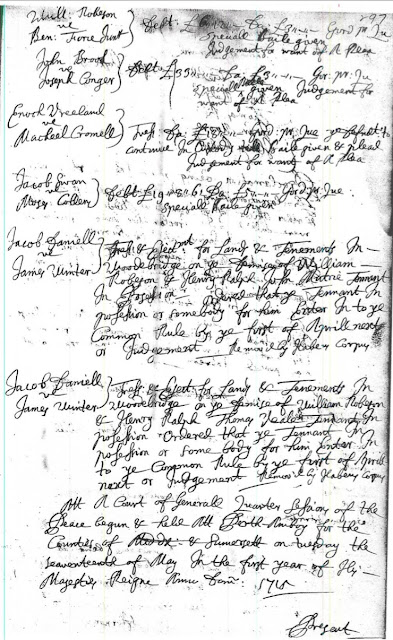
I apologize for being off the grid for many months now...it is a busy world out there.  In any case, here are the first set of documents I promised in the fall.  They are a collection of excerpts from a 1715-1716 court case against Samuel Bonnell (1) in the combined Middlesex and Somerset County Court found in the New Jersey State Archives in Trenton.  Samuel (1) [CB280017] was the son of Nathaniel Bonnell of Elizabethtown, New Jersey, who was, in turn, the son of William, the original immigrant.

There are five related references.  

  • The first two are just calls for his appearance before the case went in front of the Grand Jury.  
  • The third excerpt is the Grand Jury ruling sending the case to trail.  
  • The fourth reference is his conviction with an appeal by his lawyer.  
  • The last reference is the failure of the appeal and the resulting fine.  

The charges in the case were fornication and cohabitating with another man's wife.

Overall, the case supports William Austin's speculation (described in his book) that Samuel (1) split from his first wife (Abigail) some years before. Samuel then apparently took up with another woman, perhaps the Susannah Randolph we see mentioned in 1728.  Before we criticize Samuel (1) too quickly, I think Samuel's "not guilty" plea and effort to argue his "reasons" on appeal indicate that it may not have been a simple situation. Whoever the woman was, she appears to have been the mother of Samuel Bonnell (2) who was the father of William Bonnell of Mercer County, Kentucky.
If nothing else, these documents prove that Samuel (1) was still alive and kicking in 1716.  He did not die in 1715 as listed in Austin's book.  As you remember, we have already discounted that as confusion with the death of a Samuel Bonnell child of another New Jersey line.
Also, there are some tantalizing clues to explore.  First, the witnesses against Samuel appear to have been Hugh and Agness Reid.  I searched through New Jersey documents and did find the elderly widow Agness Read as the Plaintiff in a 1741 court case in Middlesex County.  I read the one document regarding this later case, but there was nothing I could find that would connect back to the Bonnells.  What I have yet to investigate, however, are Mr. Vernon who was Samuel Bonnell's lawyer in the case, and William Ilshe (can use help confirming the last name) who appears to have been his surety for bail after the Grand Jury indictment.  Perhaps these individuals will point to where Samuel (1) may have been living at the time.

Finally, the fact that the first reference is "bound over" indicates that there must be a prior, initial reference to this case in the order books.  I looked carefully while I was in the archives and did not catch it.  Either I missed it (entirely possible since the records from this time are so difficult to read), or it occurred in one of the gaps in the fragmentary
order record.

George Farris added:

Thanks, John.  I don't find anything to add regarding the people involved in this case other than that several were from Woodbridge.  And we had earlier found a reference to the fine in the Woodbridge records in 1715 - so Samuel  was still living in Woodbridge at the time of these court actions. One little dichotomy is that Susannah was listed as his wife in the 1707 birth record for Samuel, Jr. and in 1815 he was charged for living with someone else's wife.  I don't think there are enough surviving records to sort this out completely.  There were other Reids/Reads in Woodbridge but I haven't seen any other reference to Hugh and Agness Reid.

Regarding the surety for Samuel Bonnell referenced in one of these records, there were several members of a family in Woodbridge at that time as referenced in Joseph W. Dally's book whose names are variously spelled Illsley, Inslee, Ilsly, Ileslee, and Ilslie.  It appears that William Ilslie was the one who was the surety for Samuel.  He was married in Woodbridge in 1700 and was one of the surveyors for the several additions to Woodbridge over the years.
=====================================
Transcription

17 May 1715 (p. 297-298):
Dom Rex }
   v } bound over by Recognizance being call’d Appeared & continued on his 
Samuell Bonnell } Recognizance till next Court 
Hugh Reid & Agness his wife sworne & sent to the Grand Jury – then the Court
Ajourned till two a Clock In the Afternoone

16 August 1715 (p. 303-304):
Dom Rex }
   v } bound over by Recognizance being call’d Appeared
Samuell Bonnell }

17 August 1715 (p. 305):
The Court mett According to Ajournment.  Then the Grand Jury came Into Court were call’d over & brought In ye following – Indictment (viz) one Against John Moore for forcibly carry away Rails belonging to David Donham to which sd Moore pleaded guilty & submitted to ye bench who fined him six Schillings & pd.  one Against Samuell Bonnell for fornication who pleaded not guilty & In open Court Acknowledged himselfe to be Indebted to our Sovereigne Lord ye King In ye sum of twenty pounds & William Ilshe did Also Acknowledge himself In ye Sum of twenty pounds on condition that ye sd Samuell Bonnell Appear & answer at ye next court/  And an other Indictment Against Thomas Litten and Hannah Litten for fornication & one Against George Davison for fornication Against whom the Court orders prosecution/ then ye Grand Jury having no further business to do were discharged--

15 November 1715 (p. 308)
Dom Rex }
   v } upon an Indictment for fornication to which he pleaded not guilty & on ye tryall
Samuel Bonnell } ye Jury found him guilty Mr Vernon on behalf of ye defendant moved for a 
rreetal Judgement ye reason whereof ye Court will consider of.

21 February 1716 (p. 311)

Dom Rex }
   v } as an Indictment of Cohabitating with another man’s wife & it was argued 
Samuel Bonnell } before the Bench    M Gordon pro for ye Planiff 
M Vernon pro for ye Defndt.  
the Court overruled the Defndts Reasons and fined him the D Samuell Bunell 
in the sum of fifteen pounds and the Costs to be in the Sheriffs Custody till

payment be made
====================================================


Wednesday, March 1, 2017

Who Was Joseph Bonnell's First Wife, if Rebecca Dod(d) Riggs Was His Second Wife?


Charlie Bonnell asked me to post this–can anyone help?

A typical genealogical puzzle – Joseph Bonnell, 280016 in Claude’s database, supposedly married Rebecca Dod(d) in 1705 and they supposedly had 4 children: Joseph, 1706-1761; Phebe, 1708-; Keziah, 1710-1759; Samuel, 171_ - ?.  The problem is Rebecca was the widow of Samuel Riggs who didn’t die until about 1709/1710.

In the New Jersey Calendar of Wills, 1670-1760, page 386 (see screen shot below, from Ancestry.com:  Samuel’s will was dated 31 Jan 1709 and made his wife, Rebecca the executrix. The will was proved May 16, 1711, “and on the same day the executrix, then wife of Joseph Bunnell, sworn in.” 

Rebecca and Samuel had one child, Sarah Riggs born in 1710. 

So it appears that the earliest that Rebecca and Joseph would have likely married was 1710. Thus, Joseph’s first 2 children, Joseph and Phebe, should not have been Rebecca’s.

Has anyone found anything that would lead to a name for a probable first wife of Joseph before Rebecca?